
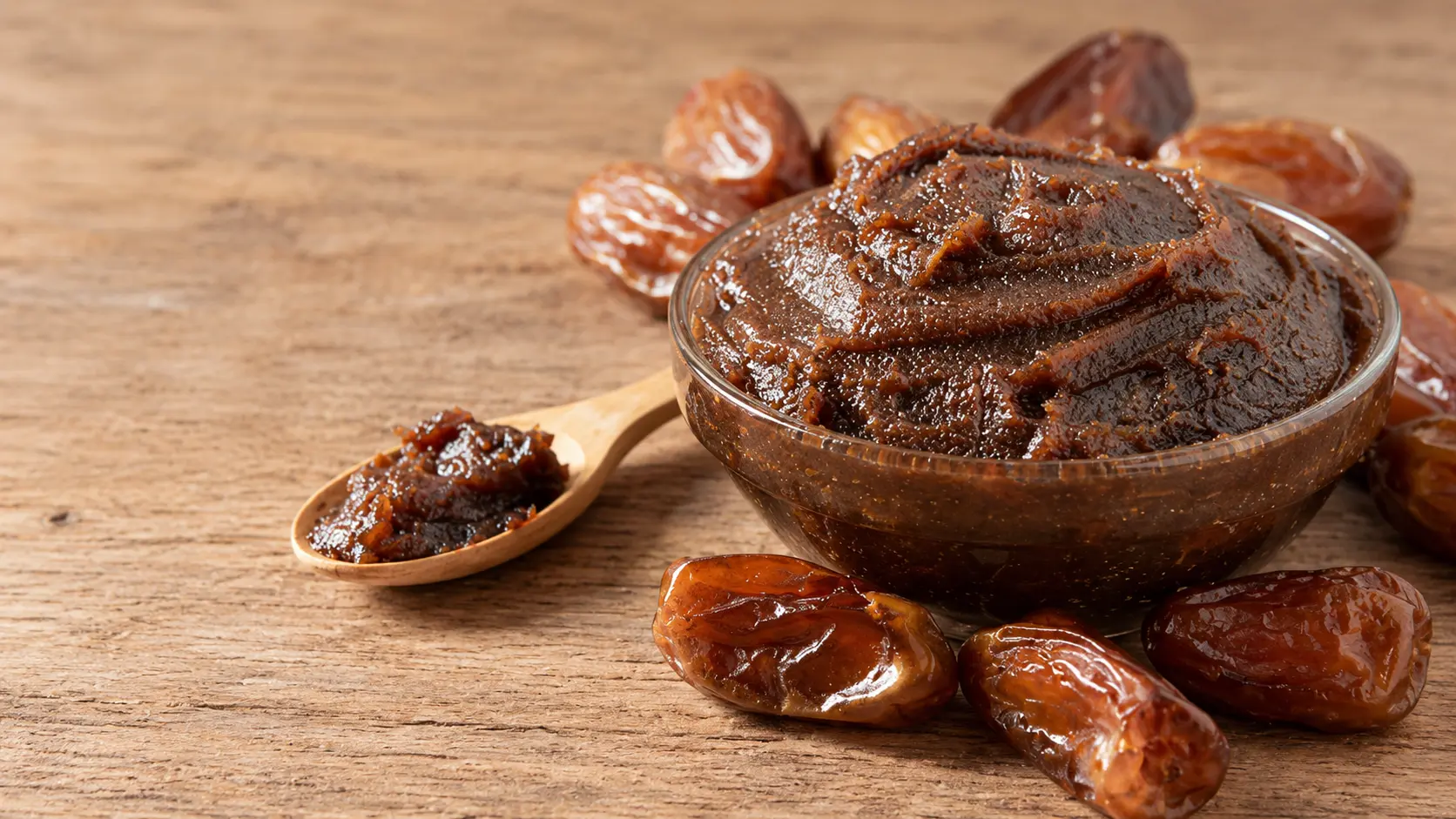
Date Paste for Food Manufacturing: What to Know
More and more bakery and snack manufacturers are turning to date paste as a simple, fruit-based ingredient for cleaner, more natural recipes. Whether you are new to the industry, preparing a first bulk order or gradually moving a range toward cleaner labels, the questions tend to be the same: which cultivar, which grade, and which specifications count most?
This guide walks through them step by step, so purchasing, R&D and quality teams can compare offers on the same basis and choose with confidence.
Which parameters matter for each application?
Date paste brings sweetness, binding, texture and a fruit-based ingredient declaration to bakery, snack bars, fillings, sauces and plant-based products. The right paste is not the most expensive one, but the one that meets your performance, sensory and cost requirements.
Cereal bars, sauces and spreads need binding, viscosity and pit control at the right price, so an industrial or standard paste is usually enough.
When the paste is seen or tasted, as in filled biscuits, maamoul and pastries, a Deglet Nour paste or premium grade brings the smooth texture and mild flavour required. For premium retail, origin and appearance come first, and Deglet Nour or Medjool stand out.
Which date cultivars make the best paste?
Cultivar shapes colour, sweetness and texture. Here are the main options from North Africa and the Middle East.6,7,9–13
North Africa. Tunisia and Algeria are home to Deglet Nour, a semi-soft date with a delicate, honey-like taste that gives a light amber to golden paste, ideal when colour and mildness matter. For a darker, sweeter result, Ghars is soft, sticky and caramel-like, and one of the best cultivars for paste. Tunisia also grows Allig and Khouat Allig, semi-soft brown dates with a sweet, sometimes mildly acidic taste that process very well. Drier cultivars such as Kentichi (Tunisia) and Degla Beida (Algeria) are paler and only mildly sweet, so they work best in blends. Further west, Morocco’s Medjool, now grown worldwide, is large and fleshy, with a rich caramel flavour and a dark, reddish paste.
Middle East. Iraq and Iran supply Sayer, a soft, slightly caramelised date that makes excellent paste, while Iraq’s semi-dry Zahidi is golden brown with a mild, nutty taste. In the Gulf, Saudi Arabia and the UAE produce Khalas and Sukkari, both soft and amber to golden: the first rich and caramel-like, the second very sweet and honeyed. Finally, Saudi Khudri, semi-dry and dark brown, is moderately sweet and gives a good paste.
Deglet Nour can also differ in sugar profile, with sucrose often dominant, while many other cultivars are richer in glucose and fructose, according to a 2023 study of Tunisian cultivars14. Blending soft and dry cultivars can balance sweetness, colour and cost, once validated in trials.7,8
Note: these profiles are indicative; confirm them on real samples, as ripeness, moisture and processing all play a role.
Premium or industrial grade: what’s the real difference?
“Premium” and “industrial” are commercial classifications, not Codex grades, and their meaning varies from one date paste supplier to another. A measurable specification is always safer than a grade name.
Premium grade suits consumer-facing products and private label: the fruit is more carefully sorted, so colour, flavour and texture are more uniform.
Industrial grade suits high-volume bars, bakery and sauces: it may include smaller or imperfect dates and accepts wider visual tolerance, but must meet the same strict limits for pits and foreign matter.
In short, choose premium if your customer sees or tastes the date, and industrial if consistent performance at the right cost comes first.
NOTE The same baseline applies to every grade. Industrial grade never justifies pits, foreign matter, mould, fermentation or missing documentation.(1)
What does good-quality date paste look like?
Under Codex CXS 314R-2013, good date paste is soft, uniform in colour and texture, free from pits, stalks and foreign matter, with a maximum moisture of 20%.1 For a clean-label ingredient, the declaration should simply read 100% dates.
Physico-chemical specification. Moisture generally sits at or below 20%, with water activity (aw) typically around 0.58–0.67, soluble solids at 70–79 °Brix, and pH at 4.5–5.5.¹˒²˒⁸˒¹⁵ Values outside these ranges may indicate differences in formulation or processing and can warrant further investigation for potential dilution, crystallisation, fermentation, or shelf-life concerns.
Sensory and physical quality. Colour should match an agreed L*a*b* standard, texture should be homogeneous and pumpable, and flavour clean, with no fermented or rancid notes.16 Any pit, glass, metal, plastic or mould means rejection.1
Microbiological criteria. Typical limits are a total plate count below 10,000 CFU/g, yeasts and moulds at 100–1,000 CFU/g, E. coli not detected and Salmonella absent in 25 g.17–20
Finally, check the product identity (paste, purée or syrup), the analytical method, and whether the certificate of analysis (CoA) covers a single sample or a composite lot.
Note: these are practical targets unless marked as legal requirements; microbiological limits are set by national law or customer specification.
Want to see real values? Discover Our Date Paste Technical Data Sheet.
What should you check before a bulk order?
- Compare each date paste supplier on the same basis: same specification and Incoterm (FOB, CIF or DAP), not price alone.
- Approve a real production sample, and check that its colour suits your recipe.
- Ask for a TDS and CoA for the actual lot, with agreed limits in writing.
- Check market documents, such as pesticide-residue and mycotoxin results, which EU buyers routinely expect3,4.
- Agree packaging and logistics: pallets, food-grade liners, storage and minimum shelf life.
- Keep claims measured: date paste is naturally rich in sugars, and “no added sugars” claims fall under EU Regulation 1924/20065.
Frequently asked questions
What is the maximum moisture content for date paste?
Codex CXS 314R-2013 sets a maximum of 20% for date paste. Many commercial specifications work with a lower target to improve stability.1
Is date paste a clean-label ingredient?
It can be, when the ingredient list reads 100% dates with no added syrup or sugar. Claims such as “no added sugars” remain regulated in the EU.5
Are premium and industrial grades defined by law?
No. They are commercial classifications. Both must still be free from pits, foreign matter and mould.1
Looking for bulk date paste? | yakutta.com |
Sources
- Codex Alimentarius. Regional Standard for Date Paste (Near East), CXS 314R-2013.
- Barreveld, W.H. Date Palm Products. FAO Bulletin 101, 1993.
- CBI. Entering the European Market for Dates.
- EU Regulation (EC) No 396/2005 on pesticide residues.
- EU Regulation (EC) No 1924/2006 on nutrition and health claims.
- Rheology and tribology of date pastes from different cultivars. J. Food Process Eng. doi:10.1111/jfpe.13891
- Value-added products from fresh date fruit. Food Bioprocess Technol., 2023. doi:10.1007/s11947-023-03189-9
- Ahmed, J. and Ramaswamy, H.S. Physico-chemical properties of commercial date pastes. J. Food Eng., 2006.
- Chemical properties of date paste. journals.ekb.eg
- CNN classification of date palm fruits. PMC10818393.
- Valorization of date fruit and its co-products. PMC10094366.
- Nutrient-dense Medjool date-based products. PMC12984689.
- FAO. Botanical and systematic description of the date palm.
- Sugar composition of Tunisian date cultivars, 2023. doi:10.1155/2023/2474900
- Valorization of date fruit processing by-products. PMC3730931.
- Rheological and textural characteristics of date paste.
- BATA Food. Organic date paste specification (industry spec).
- GSO 1016/2015. Microbiological criteria for food products.
- Nuts in Bulk. Date paste microbiological specification (market practice).
- SciELO, Food Sci. Technol. Microbiology of date products.
 EN
EN  FR
FR  ES
ES  DE
DE  IT
IT