
What Are The Date Paste Uses for Food Manufacturers?
Date paste uses in food manufacturing extend well beyond simple sweetening. Manufacturers use it to add sweetness, body, moisture, binding performance, fruit flavour and colour to snack bars, bakery products, confectionery, cereals, fillings, sauces and foodservice recipes. However, the correct paste depends on the application. Texture, date variety, moisture, Brix, particle size, ingredient declaration and packaging can all affect production performance. Commercial buyers should therefore evaluate date paste as a functional ingredient rather than purchasing only on price per kilogram.
What is date paste?
Date paste is generally produced by removing the pits from dates and processing the fruit flesh into a smooth or dense paste. Its precise composition and consistency depend on the date variety, moisture content, processing method and whether water or other ingredients have been added.
The FAO classifies paste among the established products made from whole date flesh, alongside preserves, condiments, breakfast foods and desserts. Scientific literature also identifies date ingredients as useful materials for bakery, confectionery and other processed-food applications.
For a manufacturer, the term date paste is not a complete specification. One product may be soft enough for pumping and blending, while another may be delivered as a dense block intended for cutting, depositing or extrusion. Buyers should confirm the exact product profile before approving a quotation.
Date paste for energy bar manufacturing
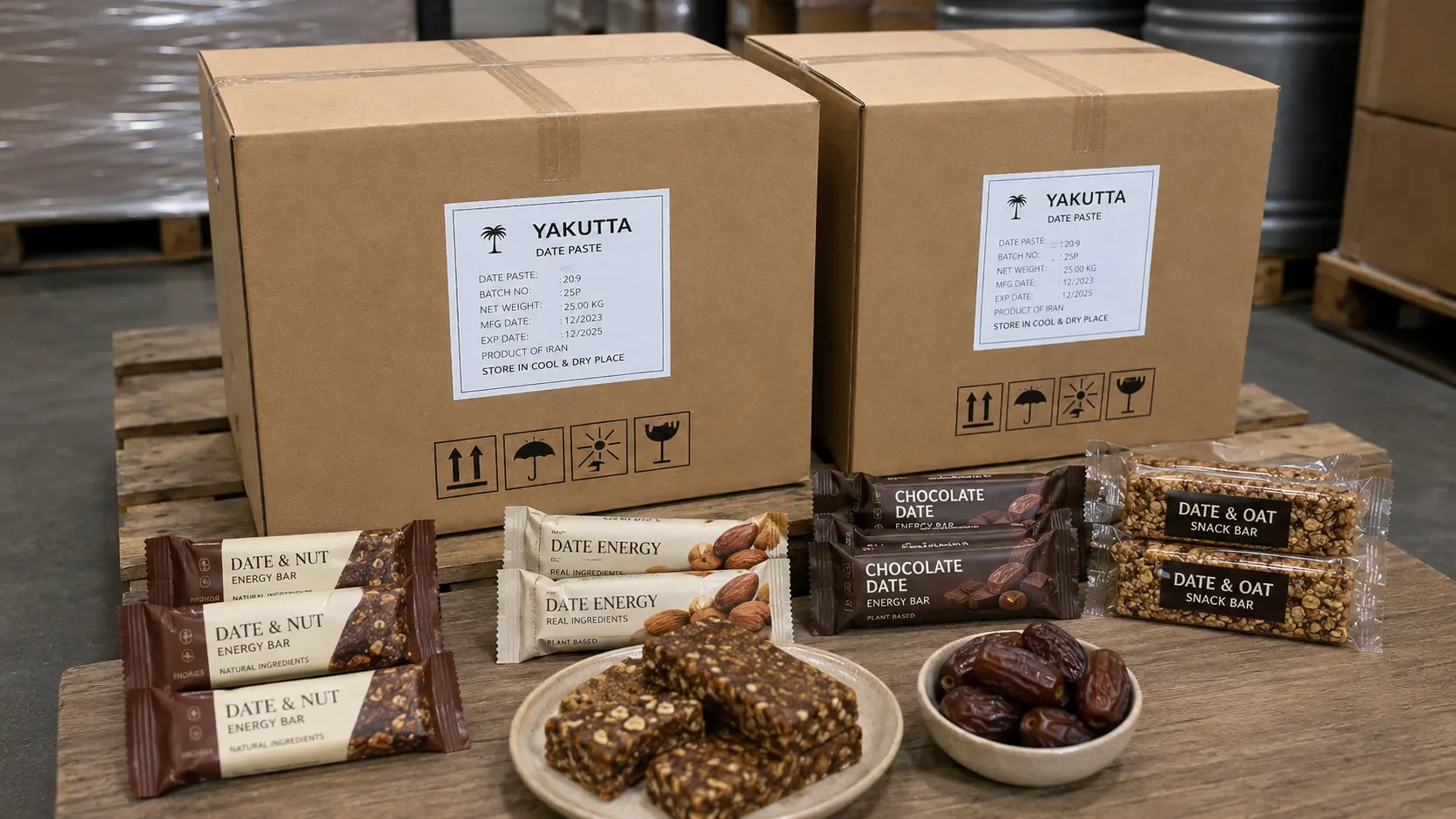
Date paste for energy bar manufacturing is one of its most commercially relevant applications. Its sticky structure can help combine cereals, nuts, seeds, protein ingredients and fruit pieces while also contributing sweetness. Research on date-based bars shows that dates have been evaluated with ingredients such as oats, nuts, sesame and protein components. Formulation studies also demonstrate that changing the proportion of date paste affects cohesiveness, chewiness, moisture and overall acceptability.
Date paste energy balls
Date paste energy balls use the same binding principle on a smaller or differently shaped product. The paste can help nuts, seeds, cocoa, coconut and cereal powders remain together without a separate syrup.
For commercial production, buyers must evaluate depositability, rolling or forming performance, finished-product water activity and packaging stability. A home recipe may only need to hold together for immediate consumption; a retail product must remain consistent throughout its intended shelf life.
Date paste for baking
Date paste for baking may be used in bread, cookies, biscuits, muffins, cakes, pastries and fruit fillings. Date ingredients can contribute sweetness, moisture, colour and softness, while the whole fruit solids make their behaviour different from dry sucrose or liquid syrup. Research reviews have documented date use in bread, cookies and other bakery formulations. Manufacturers should not assume that date paste can replace granulated sugar at the same percentage in every recipe. Adding paste changes the formulation’s water, fruit solids, fibre and colour. It may therefore require adjustments to flour, added liquid, fat, mixing time, leavening or baking conditions. Relevant trial measurements include: Dough or batter consistency, spread during baking, finished-product height, browning, softness, moisture retention, sweetness perception, flavour compatibility, and shelf-life development.
Confectionery, fillings and shaped products
In confectionery, date paste can become a centre, layer, truffle base or mouldable fruit component. It pairs naturally with nuts, cocoa, sesame and coconut, but the required texture varies considerably.
A soft paste may work well in a blended centre, whereas a firmer paste may be preferable for depositing, cutting or shaping. Colour is also important: a dark paste may suit chocolate applications but could change the expected appearance of a lighter bakery filling.
For filled products, buyers should discuss pump pressure, nozzle dimensions, depositing temperature and whether the paste must remain stable during baking or cooling.
Cereals, granola and snack clusters
Date paste may bind granola clusters or combine cereal ingredients in compressed snacks. In these applications, manufacturers must balance adhesion against excessive stickiness.
A paste with too much available moisture may soften crisp cereal components. A paste that is too firm may not distribute evenly. Trials should therefore monitor cluster formation, cereal texture, storage conditions and moisture movement across the finished product.
Sauces, spreads and foodservice products
Sauces, marinades, dressings, chutneys and spreads represent additional industrial date paste applications. The ingredient can provide fruit sweetness, body and a darker flavour profile.
A sauce manufacturer may require a smoother, more dispersible paste than a snack-bar producer. The product must blend into the liquid phase without leaving unwanted particles or blocking processing equipment. For foodservice buyers, packaging should also support safe portioning, efficient storage and manageable handling after opening.
Is date paste healthy?
The question “is date paste healthy?” cannot be answered with a universal marketing claim. A paste made only from whole dates retains fruit solids and may provide fibre and minerals that refined sugar does not provide. However, it also contains substantial naturally occurring sugars and contributes energy.
Its suitability depends on the serving size, total formulation, nutritional targets and claims permitted in the destination market. Manufacturers should calculate nutrition using the actual recipe and verified supplier information rather than copying values from whole dates or an unrelated retail paste.
Date paste calories
Date paste calories vary with date variety, water content and added ingredients. A more hydrated paste may contain fewer calories per 100 g than a denser product, but it may also require a different usage rate.
USDA FoodData Central distinguishes between commodity, experimental, survey and branded-food data because nutritional composition depends on the specific food record and source. Commercial buyers should therefore obtain batch- or product-specific nutritional information for labelling and formulation work.
Date paste glycemic index
There is no single verified date paste glycemic index that applies to all varieties and formulations. Research on whole date fruit has found considerable variation. One study of 17 varieties reported values ranging from 42.8 to 74.6, while another study of five varieties found a narrower range. These results concern whole dates and should not automatically be assigned to processed date paste or a finished food.
Finished-product glycaemic response may also be influenced by portion size and the other carbohydrates, fats, proteins and fibres in the formulation. Manufacturers planning a glycaemic claim should arrange appropriate product-specific testing.
Date paste specifications buyers should review
| Parameter | Why it matters |
|---|---|
| Ingredient declaration | Confirms whether the product contains only dates or includes water, oil or other ingredients |
| Date variety | Can influence colour, flavour, sweetness and texture |
| Brix | Indicates soluble-solids concentration but does not replace a complete compositional analysis |
| Moisture | Affects firmness, mixing, storage and finished-product formulation |
| Water activity | Helps quality teams evaluate product stability and moisture behaviour |
| Texture or firmness | Determines blending, pumping, depositing, cutting and extrusion suitability |
| Particle size | Influences smoothness, mouthfeel and equipment compatibility |
| Colour | Affects the appearance of bakery, dairy, snack and confectionery products |
| Pit-fragment control | Important for food safety, equipment protection and finished-product quality |
| Microbiological limits | Must match the buyer’s product and quality requirements |
| Shelf life and storage | Affect inventory planning and warehouse conditions |
| Packaging | Influences handling, contamination control, waste and freight efficiency |
Codex guidance for date paste addresses raw-material quality and the control of pits, insects and extraneous matter, reinforcing the importance of documented physical-quality requirements.
Samples, COA documents and quality verification
A sample allows product-development teams to evaluate flavour, colour, firmness, blending, depositing and finished-product performance. The tested sample should correspond as closely as possible to the specification proposed for commercial production.
A certificate of analysis, or COA, may include agreed batch results such as moisture, microbiological parameters or other specified characteristics. Buyers should clarify which values appear on every batch-level COA and which information is provided only on the general specification sheet.
Before approval, ask:
- Is the sample representative of regular production?
- Which parameters are tested for each batch?
- What pit-fragment controls are used?
- Can the supplier provide traceability information?
- What tolerances apply to moisture, colour and texture?
- How are non-conforming batches managed?
Why work with Yakutta?
Yakutta supports manufacturers, distributors, importers, foodservice operators and private-label brands seeking date paste in commercial quantities. The sourcing process can cover product-profile review, packaging selection, samples where available, applicable COA documentation, bulk pricing and international shipment planning.
This specification-led approach helps buyers compare offers more accurately and select date paste that is suitable for their actual processing application.
Conclusion
The most valuable date paste uses for manufacturers include sweetening, binding, moisture management, filling, shaping and flavour development. However, success depends on matching the paste to the recipe, equipment, packaging and shelf-life target.
Professional buyers should compare ingredients, variety, Brix, moisture, water activity, texture, particle size, pit-fragment controls, COA coverage and landed cost before confirming bulk supply. Testing the proposed product under real production conditions remains the most reliable way to determine suitability.

 EN
EN  FR
FR  ES
ES  DE
DE  IT
IT