
Deglet Nour Date Paste Technical Data Sheet
Below is the technical data sheet for our 100% Deglet Nour date paste from Tunisia. Made only from dates grown in the Jerid, Kebili and Regim oases, it has a mild, honey-like profile and a homogeneous texture suited to bakery, biscuit fillings, snack bars and other food applications. Values are specification limits; results for each lot are reported on the certificate of analysis.
01- Product identification
Our date paste is made from 100% Deglet Nour dates grown in Tunisia’s Jerid, Kebili and Regim oases, processed and presented as a paste. Only sound fruit is used: dates affected by rot or deterioration are excluded, and the paste is clean, practically free of visible foreign matter, and free from damage and fermentation.
02– Physical characteristics
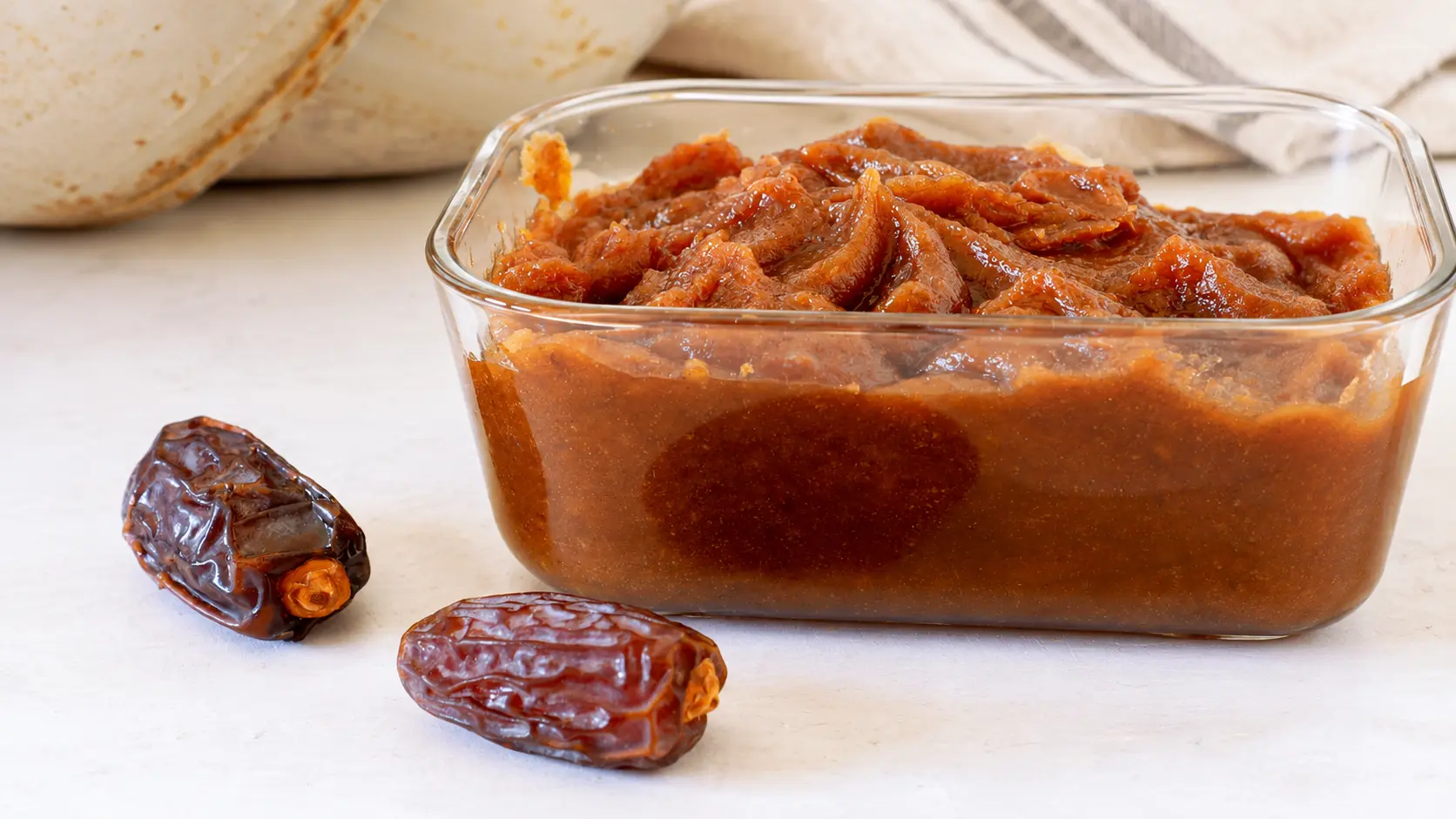
The paste is amber to brown, with a homogeneous texture and the typical smell and flavour of Deglet Nour dates, free from any foreign odour or flavour.
It contains no pits or pit fragments, perianths, black mould, hair, plastic, glass or metal, no other foreign bodies (textiles, wool, paper, dirt, wood, etc.) and no live infestation.
03– Chemical characteristics
Pesticide residues comply with Regulation (EC) No 396/2005 for conventional product and Regulation (EU) 2018/848 for organic product. Mycotoxins and contaminants meet Regulation (EU) 2023/915, and the paste is non-GMO under Regulations (EC) No 1829/2003 and 1830/2003.
Water content | 16–20% (target 17.5% ± 1%) |
Water activity (aw) | 0.610–0.670 |
Sugars | 68–85% of dry matter |
Aflatoxins | B1 ≤ 2 µg/kg │ B1+B2+G1+G2 ≤ 4 µg/kg |
Ochratoxin A | ≤ 2 µg/kg |
Heavy metals | Lead ≤ 0.10 mg/kg │ Cadmium ≤ 0.02 mg/kg |
Perchlorate | ≤ 0.05 mg/kg |
04– Biological characteristics
Yeasts and moulds | ≤ 1,000 CFU/g |
Microorganisms at 30°C | ≤ 10,000 CFU/g |
Bacillus cereus | ≤ 1,000 CFU/g |
E. coli | < 10 CFU/g (not detected) |
Salmonella | Not detected in 25 g |
Listeria monocytogenes | Not detected in 25 g |
05– Production and packaging
Process. Dates are picked at the right stage of maturity, disinfested and kept in cold storage. They are then pre-sorted, cleaned to remove defective fruit and foreign matter, freed from the perianth and washed, before being dried or hydrated to adjust their water content, then pitted, ground and shaped. Every pack passes through a metal detector before labelling and palletising, and is kept in cold storage until dispatch.
Packaging and transport. The paste is packed in food-grade blue bags inside 10 kg or 12.5 kg cartons, at 1 tonne per pallet, and all materials in contact with the product are new, clean and food-grade. It ships in insulated or refrigerated containers or semi-trailers.
Shelf life and storage. Shelf life is 18 months at room temperature, away from heat and humidity, with optimal storage at 0–4 °C and 55–65% relative humidity. Nutritional values per 100 g are available on request, based on a Veritas laboratory analysis report.
06– Labelling and regulatory
Labelling complies with Regulation (EU) No 1169/2011 and covers name, ingredients, allergens, net quantity, best-before date, storage conditions, operator details, origin and nutrition declaration. The paste is suitable for the general population, with caution advised for some types of diabetes. It is not treated with ionising radiation and complies with Council Regulation (Euratom) 2016/52 on radiological parameters.
07– Allergens and intolerances
The paste contains none of the 14 EU-regulated allergens, sulphites included, and none are handled on the same line or in the same factory, so there is no risk of cross-contact.
Need the CoA for a specific lot? | yakutta.com |

 ES
ES  EN
EN  FR
FR  DE
DE  IT
IT