
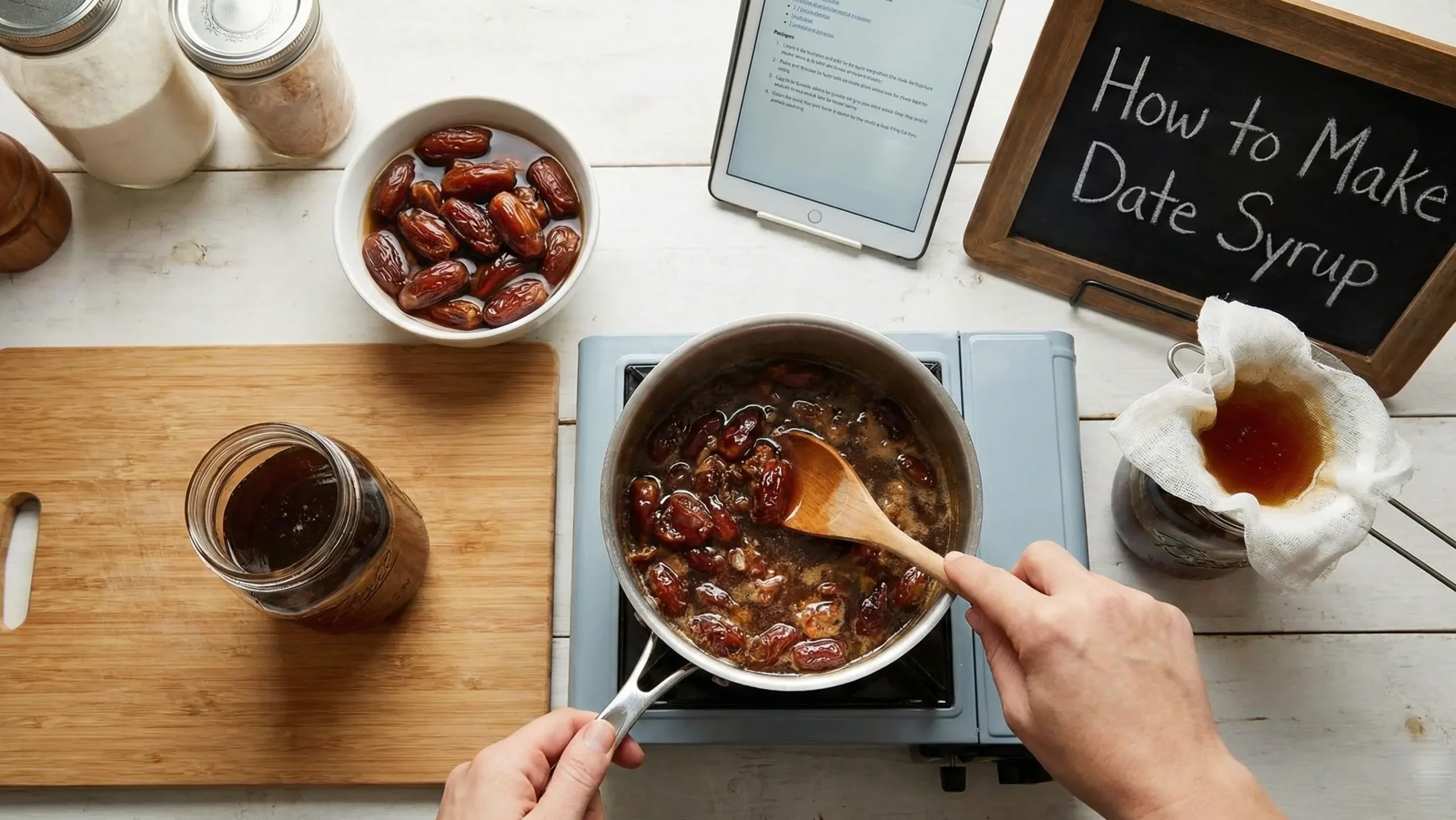
How to make date syrup
In the quest for healthier, more natural alternatives to refined sugar, many of us find ourselves staring at supermarket shelves, bewildered by the sheer number of options. The choices are endless, yet often highly processed. But what if the perfect natural alternative was a date sweetener you could create in your own kitchen with just two simple ingredients?
Date syrup (often called “date honey” or “silan” in the Middle East) is one of the oldest sweeteners known to humankind.
Learning how to make date syrup is surprisingly simple. It requires patience rather than advanced skills, and the result is a versatile pantry staple that tastes far superior to most store-bought versions. In this guide, we will walk you through exactly how to make date syrup at home, ensuring you achieve that perfect, glossy consistency every time.
Why Make Your Own Date Syrup?
Before we dive into the method, it is worth understanding why this DIY project is worth your time. When you opt for homemade date syrup, you have complete control. You determine the thickness, the sweetness intensity, and, most importantly, the quality of the ingredients.
This syrup is a lower-glycemic alternative to white sugar, meaning it releases energy more slowly into the bloodstream. It is naturally vegan, gluten-free, and paleo-friendly. Plus, the byproduct of making syrup is a fantastic ingredient in its own right, perfect for baking or adding fibre to smoothies. Nothing goes to waste.
The Core Ingredients: Simplicity at Its Best
The beauty of this date syrup recipe lies in its minimalism. You do not need preservatives, thickeners, or artificial flavourings. You only need two things:
- Dates
- Water
Choosing the Right Dates
While you can technically use any variety of date, the quality of your fruit will directly impact the flavour and ease of the process.
Medjool dates are widely considered the gold standard. They are large, fleshy, and naturally very soft, with a high moisture content and an intense, caramel-like sweetness. Their soft texture means they break down easily during simmering, allowing you to extract the maximum amount of sugar.
However, Medjool dates can be pricey. If you are looking for a more budget-friendly option, Deglet Noor dates are a fantastic alternative. They are slightly drier and firmer, with a lighter, nuttier flavour profile. If you use Deglet Noor or other drier varieties, you simply need to be a bit more patient during the soaking and simmering stages to ensure they fully rehydrate.
The Water Factor
Since water is the only other ingredient, ensure it is fresh and filtered if possible. The water acts as the solvent, extracting the sugars and flavours from the fruit before being reduced down to concentrate that sweetness.
A Step-by-Step Guide on How to Make Date Syrup
Making date syrup is a process of extraction and reduction. We want to coax all the sugar and flavour out of the fibre and into the water, remove the solids, and then boil off the excess water until we are left with pure nectar.
Here is your comprehensive guide on how to make date syrup from scratch.
Step 1: Prep and Soak
Preparation is key. If your dates have pits, you will need to remove them first. Even if you buy “pitted” dates, it is always wise to double-check them; a stray pit can wreak havoc on your blender later or add a bitter taste.
- Chop the dates: Roughly chop your dates. This increases the surface area, allowing the water to penetrate the fruit more effectively.
- The Soak: Place your chopped dates in a large bowl or pot. Pour boiling hot water over them until they are completely submerged.
- Ratio: A good starting point is approximately 450g (1 lb) of dates to 1.5 litres (approx. 6 cups) of water. Don’t worry if it looks like a lot of liquid; we will reduce it later.
- Timing: Let them soak. For soft Medjool dates, 15–30 minutes is usually sufficient. If you are using drier varieties, leave them for 1–2 hours. You want the flesh to be turning pale and extremely soft.
Crucial Note: Do not discard this soaking water. It is already turning into a sweet tea, infused with the first layers of date sugar.
Step 2: Simmering to Extract Sweetness
Once soaked, transfer the dates and their soaking liquid into a large saucepan. If the water level looks low (it should cover the dates generously), add a little more fresh water.
- Bring to a boil: Set your hob to medium-high and bring the mixture to a gentle boil.
- Simmer: Immediately turn the heat down to low. You want a gentle simmer, not a rolling boil.
- Cook and Mash: Let it cook for anywhere between 30 to 60 minutes. As they simmer, use a potato masher or the back of a wooden spoon to squish the dates against the side of the pot. You want them to disintegrate into a pulpy mush.
- Visual Cue: You are done when the liquid has turned a dark, reddish-brown and the dates look like loose applesauce. The liquid should smell intensely sweet and fruity.
Step 3: Straining the Solids
This is the messiest but most satisfying part of this date syrup recipe. You need to separate the liquid “nectar” from the fibrous pulp.
- Prepare your station: Set a fine-mesh sieve over a large mixing bowl. Line the sieve with a cheesecloth or a nut-milk bag. A nut-milk bag is often easier to handle as you can twist and squeeze it vigorously.
- Pour and Cool: Pour the hot date mixture into the lined sieve. Let it cool slightly so you don’t burn your hands.
- The Squeeze: This is critical. Gather the edges of the cloth and twist. Squeeze as hard as you can. You want to extract every single drop of liquid. The liquid trapped inside the pulp is the most concentrated and flavourful part.
Tip: Save the leftover dry pulp! It is essentially pure fibre with a mild sweetness, perfect for adding to muffin batters or energy balls.
Step 4: Reduction
You now have a bowl full of thin, dark brown liquid. It will taste sweet, but watery. To turn it into syrup, we need evaporation.
- Return to Pot: Pour the strained liquid into a clean, wide saucepan. A wider pan increases the surface area, speeding up evaporation.
- Simmer Gently: Bring it to a low simmer. Do not let it boil aggressively, or you risk caramelising the sugars too much and creating a burnt, bitter taste.
- Watch Closely: Let it bubble away gently. You will see the volume decrease. This phase usually takes 20 to 45 minutes, depending on how much water you started with.
- The Spoon Test: How do you know it is ready? Dip a metal spoon into the syrup. It should coat the back of the spoon. Run your finger through the coating (carefully!); if the line stays clear and the syrup doesn’t immediately rush back to fill the gap, it is ready.
Step 5: Cooling and Storage
Turn off the heat. Let the syrup cool in the pan for about 10–15 minutes before handling. It will thicken significantly as it cools, similar to homemade jam.
- Transfer: Pour the warm syrup into a sterilised glass jar or bottle with a tight-fitting lid.
- Store: Once completely cool, seal the jar.
- Fridge: Your homemade date syrup will keep happily in the fridge for 3–4 weeks.
- Freezer: For longer storage, you can freeze it in small containers for up to 3 months. It may not freeze solid due to the sugar content, making it easy to scoop out.
Helpful Tips and Practical Details
To ensure your success with this date syrup recipe, here are some specific numeric details and troubleshooting tips to keep in mind.
Understanding Ratios and Yield
The ratio of water to dates determines your yield and cooking time.
- Standard Batch: 450g (1 lb) dates + 1.5 litres (6 cups) water.
- Yield: This typically produces about 250ml to 350ml (1–1.5 cups) of finished syrup, depending on how far you reduce it.
- Small Batch: 1 cup packed dates (approx. 200g) + 750ml (3 cups) water.
- Yield: Expect around 125ml (1/2 cup) of syrup.
Texture Troubleshooting
- Too Runny? If your syrup cools down and is still too watery, simply pour it back into the pot and simmer for another 10–15 minutes. There is no harm in double-cooking it.
- Too Thick/Hard? If you accidentally over-reduce it, it might turn into something resembling date taffy or molasses when cold. To fix this, gently warm it up with a few tablespoons of hot water and stir until it reaches the desired consistency.
Cleaning Up
Date syrup is sticky! If you spill some on your hob, wipe it up immediately with a warm, wet cloth. Once it hardens, it can be quite stubborn to remove.
Conclusion: Sweeten Your Life Naturally
Making your own syrup is a labour of love that pays off in flavour and health benefits. It is a process that connects you to an ancient culinary tradition, turning humble dried fruit into liquid gold. Now that you have mastered how to make date syrup, you will likely find endless uses for it.
Drizzle it over tahini toast, swirl it into yoghurt, or use it as a glaze for roasted vegetables. It is particularly delicious when used as a sweetener in warm beverages; try using date syrup for coffee to add a rich, caramel note that standard sugar simply cannot match.
So, grab a bag of dates, put the kettle on, and give it a try. The simplicity of transforming dates and water into a luxurious syrup is a kitchen experiment you won’t regret.

Related Posts

Best Place to Buy Essential Oils in Bulk: How to Find Trusted Wholesale Suppliers in 2025
The essential oils market continues to thrive, making it a lucrative industry for entrepreneurs and
5 Reasons Why Date Seed Oil Is the Next Big Anti-Aging Ingredient
In the ever-evolving world of natural beauty, a truly remarkable ingredient is emerging from the hea
Top 7 Benefits of Essential Oils Wholesale for Your Wellness Brand
The wellness sector is experiencing significant growth, with the global essential oils market valued
 EN
EN  FR
FR  ES
ES  DE
DE  IT
IT