
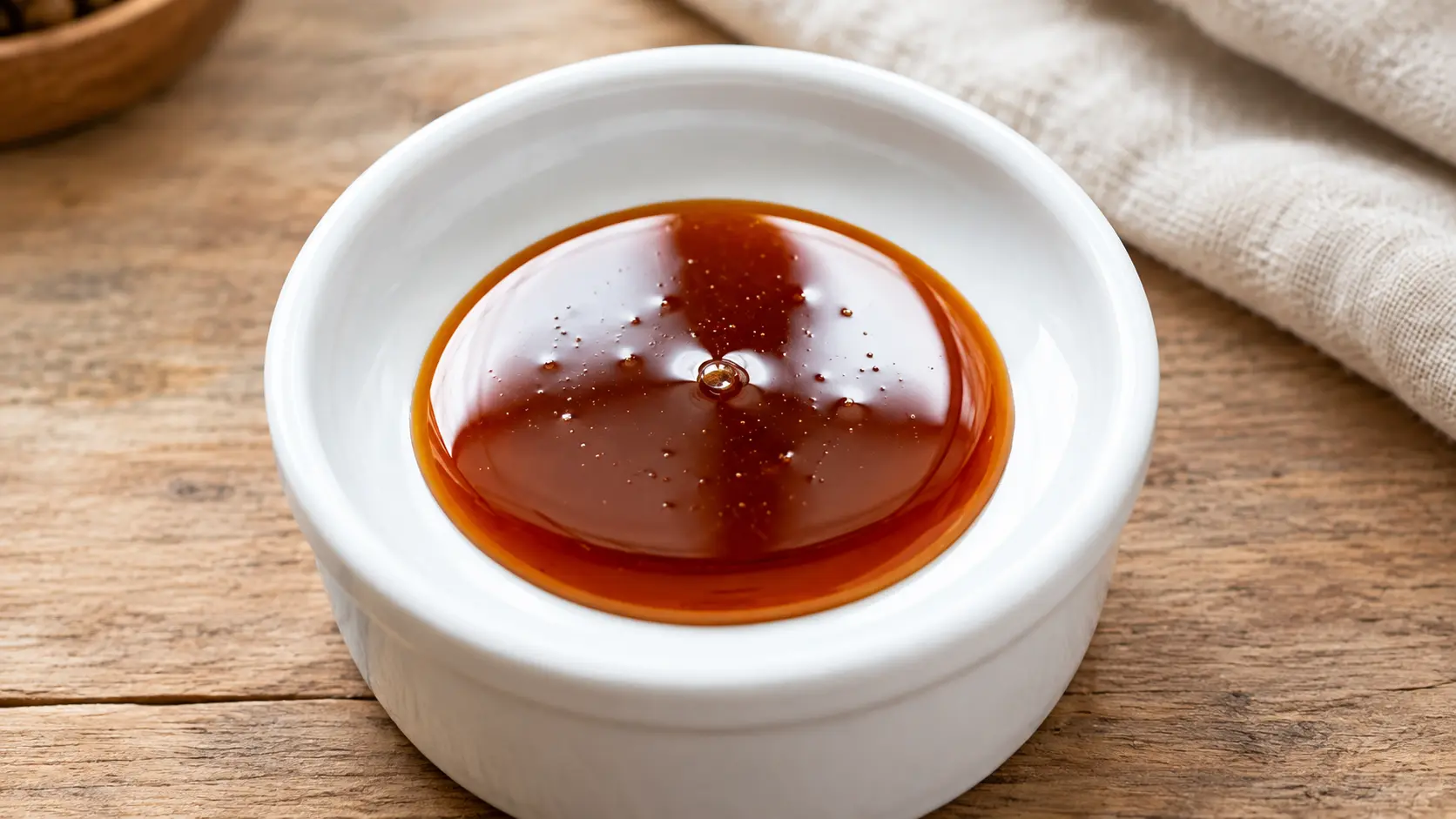
Date Syrup Technical Data Sheet: Specs, Brix & Minerals
Date syrup, also known as date honey or dibs, is obtained from ripe dates (Phoenix dactylifera L.) grown in North Africa. The juice is cold-extracted, filtered and concentrated to 75 °Brix. The syrup is not refined and contains no additives or preservatives.
75 °Brix | 4.5–5.0 pH | 0.75 Water activity | 36 Months shelf life |
01– Product identification
Date syrup is made from the ripe fruit of Phoenix dactylifera L. grown in North Africa. It has a burgundy-brown colour, contains no additives or preservatives and undergoes no refining.
02– Manufacturing process
Dates are harvested at full ripeness and undergo non-chemical disinfestation, followed by sorting, cleaning, de-stoning and crushing. The juice is cold-extracted, pressed, filtered and concentrated. No refining step is applied.
03– Physical and chemical properties
The syrup is standardised at 75 °Brix, with a pH of 4.5–5.0 and a water activity (aw) of 0.75.
04– Nutritional information
Typical values per 100 g.
Parámetro | Specification | Unit |
Energy | 262 | kcal |
Protein | 1.3 | g |
Fat | 0.42 | g |
Total sugars | 65.19 | g |
05– Minerals
Typical values.
Parámetro | Specification | Unit |
Potassium (K) | 621.6 | mg/100 g |
Calcium (Ca) | 67.3 | mg/100 g |
Magnesium (Mg) | 64.0 | mg/100 g |
Phosphorus (P) | 57.4 | mg/100 g |
Iron (Fe) | 0.274 | mg/100 g |
06– Contaminants
Heavy metals are kept below 0.2 mg/kg for lead, 0.05 mg/kg for cadmium and 0.03 mg/kg for mercury.
07– Microbiological specification
Parámetro | Specification | Unit |
Mesophilic aerobic bacteria | < 2,000 | cfu/g |
Moulds | < 100 | cfu/g |
Yeasts | < 200 | cfu/g |
Escherichia coli | < 10 | cfu/g |
Enterobacteriaceae (30 °C) | < 10 | cfu/g |
Staphylococcus aureus | < 10 | cfu/g |
Bacillus cereus | < 10 | cfu/g |
Clostridium perfringens | < 1 | cfu/g |
Salmonella spp. | < 1 | per 25 g |
Listeria monocytogenes | < 1 | per 25 g |
08– Storage and shelf life
Thanks to its high sugar content, which acts as a natural preserving agent, the syrup keeps for 36 months at ambient temperature in closed containers protected from moisture and contamination.
09– Functions and applications
Date syrup sweetens and brings fruit flavour and natural colour. Typical uses include biscuits and bakery, dairy and plant-based drinks, yoghurts and desserts, cereal and breakfast bars, confectionery, fruit-based products, ice cream and snacks, as well as retail use as an alternative to sugar or honey.
10– Product notes
The burgundy-brown colour results from the natural reaction between the proteins and reducing sugars of the dates, favoured by the heat of the regions where they ripen. The same process develops the characteristic flavour and aroma of the syrup.
Glucose and fructose are present in almost equal parts. Owing to its fructose content, the syrup is perceived as sweeter than a sucrose solution of similar concentration, which can allow lower dosage in formulation.
 ES
ES  EN
EN  FR
FR  DE
DE  IT
IT