
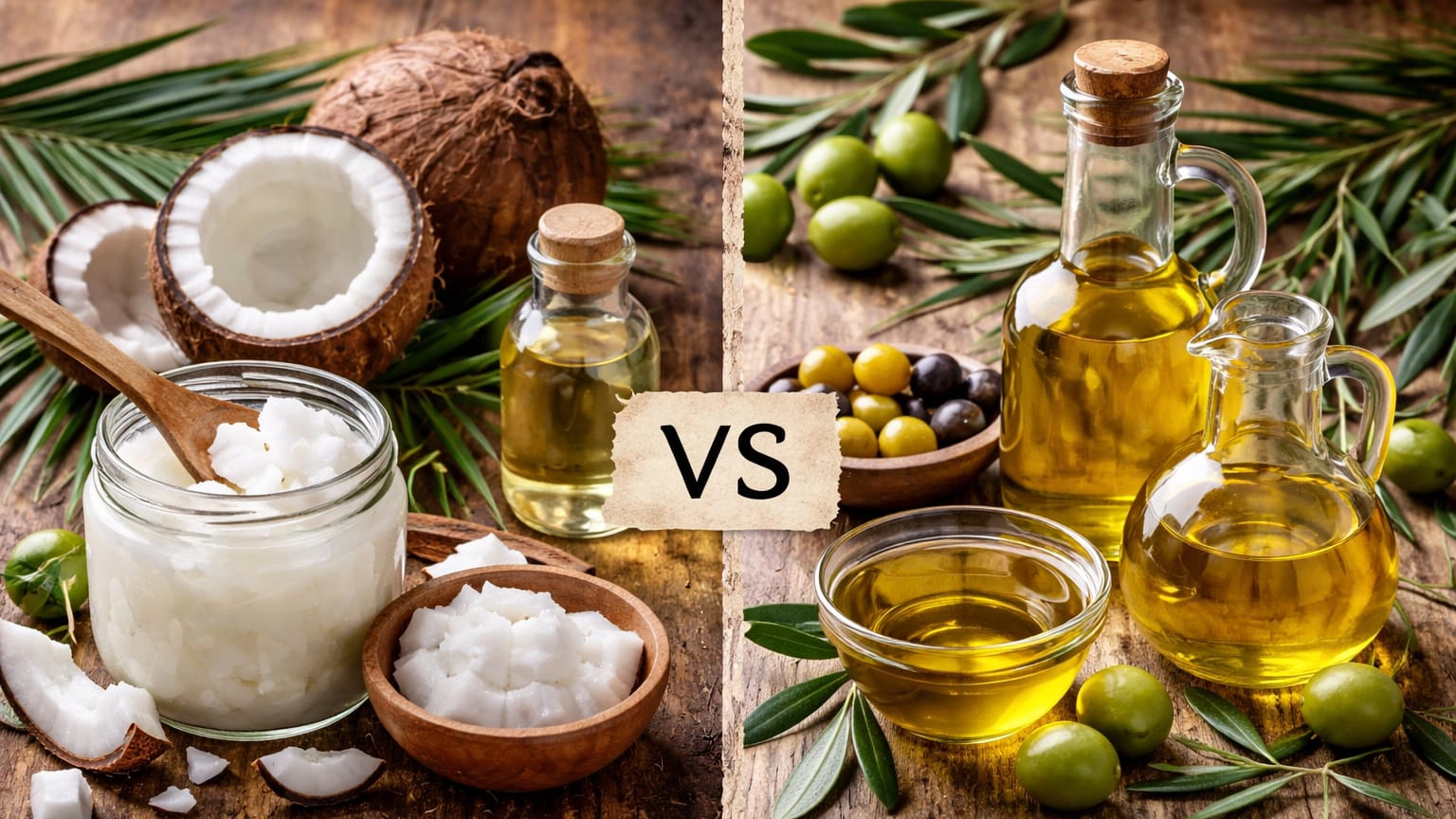
Aceite de coco vs aceite de oliva
Caminar por los pasillos del supermercado para elegir un aceite de cocina puede resultar abrumador. Quieres un producto que apoye tu salud, tenga un sabor excelente y funcione bien con tus recetas favoritas. Dos de las opciones más populares suelen dominar la conversación: el aceite de coco y el aceite de oliva. Comprender las diferencias clave en el debate aceite de coco vs aceite de oliva es fundamental para tomar decisiones dietéticas informadas.
Esta guía desglosa exactamente lo que necesitas saber sobre estos dos básicos de despensa. Exploraremos sus perfiles nutricionales distintos, cómo afectan a tu salud y las mejores formas de utilizarlos en la cocina. Al final de este artículo, sabrás exactamente qué botella escoger para preparar tu próxima comida.
El gran debate de las grasas: aceite de coco vs aceite de oliva
Cuando comparas el aceite de coco con el aceite de oliva, la diferencia más significativa radica en su composición de grasas. Ambos aceites son densos en calorías y proporcionan un contenido total de grasas similar, pero los tipos de grasa que contienen son completamente distintos.
Las grasas son un macronutriente crucial. Tu cuerpo las necesita para absorber vitaminas, proteger los órganos y producir energía. Sin embargo, no todas las grasas se comportan igual en tu organismo. El aceite de coco está compuesto casi en su totalidad por grasas saturadas, lo que lo hace sólido a temperatura ambiente y le da una vida útil más larga. El aceite de oliva, por otro lado, consiste principalmente en grasas insaturadas. Esto lo mantiene líquido a temperatura ambiente y lo convierte en un alimento básico en patrones dietéticos saludables para el corazón, como la dieta mediterránea.
Decidir entre aceite de coco y aceite de oliva a menudo se reduce a comprender cómo estas grasas específicas se alinean con tus objetivos de salud personales y tus necesidades culinarias.
Una comparación nutricional detallada
Al observar los números en bruto se obtiene una imagen clara de cómo se comparan estos aceites. Ambos aceites aportan aproximadamente 120 calorías y 14 gramos de grasa total por cucharada. Sin embargo, el desglose de esas grasas revela contrastes marcados.
Contenido de grasas saturadas
Las grasas saturadas han sido un tema de debate nutricional durante décadas. Una sola cucharada de aceite de coco contiene entre 11 y 12 gramos de grasas saturadas, lo que representa la gran mayoría de su contenido de grasa. En contraste, una cucharada de aceite de oliva contiene apenas 1,86 gramos de grasas saturadas. Si estás monitoreando activamente tu ingesta de grasas saturadas, esta métrica específica en la comparación aceite de coco vs aceite de oliva es crucial.
Grasas insaturadas
Las grasas insaturadas incluyen tanto grasas monoinsaturadas como poliinsaturadas. Los profesionales de la salud las consideran ampliamente beneficiosas para la salud cardiovascular. El aceite de oliva destaca en esta categoría. Una cucharada proporciona 9,85 gramos de grasa monoinsaturada y 1,42 gramos de grasa poliinsaturada. El aceite de coco queda muy rezagado, ofreciendo solo 0,88 gramos de grasa monoinsaturada y 0,24 gramos de grasa poliinsaturada por cucharada.
Vitaminas esenciales
Los aceites también proporcionan micronutrientes vitales. El aceite de oliva es una fuente fantástica de antioxidantes y vitaminas. Una sola cucharada aporta 1,94 miligramos de vitamina E y 8,13 microgramos de vitamina K. La vitamina E ayuda a proteger tus células del daño oxidativo, mientras que la vitamina K desempeña un papel vital en la coagulación sanguínea y la salud ósea. El aceite de coco proporciona cantidades casi despreciables de estas vitaminas, con solo 0,015 miligramos de vitamina E y 0,084 microgramos de vitamina K por cucharada.
Al evaluar el valor nutricional del aceite de coco frente al aceite de oliva, el aceite de oliva ofrece claramente una gama más amplia de grasas insaturadas beneficiosas y vitaminas esenciales.
Impactos en la salud: cómo cada aceite afecta a tu cuerpo
La composición de grasas y el contenido de vitaminas influyen directamente en cómo estos aceites afectan tu salud. Debes considerar cómo tu cuerpo procesa estos diferentes tipos de grasas.
Aceite de oliva y salud del corazón
El aceite de oliva es famoso por sus beneficios cardiovasculares. La alta concentración de grasas monoinsaturadas ayuda a reducir el colesterol LDL, a menudo llamado “colesterol malo”. Mantener el colesterol LDL bajo control reduce el riesgo de enfermedades cardíacas y accidentes cerebrovasculares. Además, los antioxidantes presentes en el aceite de oliva, particularmente la vitamina E y varios polifenoles, ayudan a reducir la inflamación en todo el cuerpo. La inflamación crónica es la causa raíz de muchos problemas de salud a largo plazo, haciendo del aceite de oliva una herramienta poderosa para mantener el bienestar general.
Aceite de coco y energía
Los efectos sobre la salud del aceite de coco son más complejos. El aceite de coco contiene un tipo único de grasa saturada conocida como triglicéridos de cadena media (TCM). Tu cuerpo procesa los TCM de manera diferente a los ácidos grasos de cadena larga. En lugar de almacenarlos como grasa, tu hígado convierte rápidamente los TCM en energía. Esta fuente de energía rápida hace que el aceite de coco sea una opción popular entre los atletas y quienes siguen dietas cetogénicas.
Sin embargo, debes equilibrar este beneficio con el alto contenido total de grasas saturadas. Consumir grandes cantidades de grasas saturadas puede aumentar tus niveles de colesterol LDL. Por esta razón, muchas organizaciones de salud aconsejan usar el aceite de coco con moderación. Al sopesar los beneficios para la salud del aceite de coco frente al aceite de oliva, la mayoría de los expertos en nutrición se inclinan por el aceite de oliva para el consumo diario a largo plazo debido a sus probadas ventajas cardiovasculares.
Usos culinarios: aceite de coco vs aceite de oliva en la cocina
Los perfiles nutricionales son solo la mitad de la historia. También necesitas saber cómo se comportan estos aceites al calentarse. El punto de humo de un aceite determina la temperatura a la que puede llegar antes de comenzar a descomponerse y liberar compuestos nocivos.
Cuándo cocinar con aceite de coco
El aceite de coco tiene un punto de humo de moderado a alto, que varía de 350°F a 450°F (175°C a 230°C), según si está refinado o sin refinar. Esto lo convierte en una opción muy versátil para cocinar a fuego medio-alto. Puedes usarlo con confianza para hornear, asar y freír. El aceite de coco sin refinar aporta un sabor tropical dulce y distintivo a tus comidas, ideal en currys, productos horneados y la cocina del sudeste asiático. Si prefieres un sabor neutro, el aceite de coco refinado permite obtener los mismos resultados de cocción sin el sabor a coco.
Cuándo cocinar con aceite de oliva
El aceite de oliva tiene un punto de humo ligeramente más bajo, generalmente entre 325°F y 410°F (165°C a 210°C). El aceite de oliva virgen extra, sin refinar y que conserva la mayor parte de nutrientes y sabor, se encuentra en el extremo inferior de esta escala. Debes reservar el aceite de oliva virgen extra para cocinar a baja temperatura, saltear o finalizar platos. Es perfecto para incorporar en aderezos, rociar sobre verduras asadas o servir con pan fresco. El aceite de oliva ligero o refinado tiene un punto de humo más alto y un sabor más neutro, lo que lo hace adecuado para freír suavemente en sartén.
Comprender las fortalezas culinarias del aceite de coco frente al aceite de oliva garantiza que tus comidas tengan un gran sabor mientras se preserva la integridad nutricional de los ingredientes.
Patrones dietéticos y elecciones de estilo de vida
Tu patrón dietético general juega un papel fundamental para determinar qué aceite se adapta mejor a ti. Ningún alimento existe en el vacío.
Si sigues una dieta mediterránea, el aceite de oliva es un elemento básico indispensable. Esta dieta se centra en cereales integrales, proteínas magras, verduras y grasas saludables, confiando en gran medida en el aceite de oliva por sus beneficios protectores para la salud. La comunidad científica clasifica constantemente la dieta mediterránea como uno de los patrones alimenticios más saludables del mundo.
Por el contrario, si sigues una dieta vegana y te encanta hornear, el aceite de coco es un ingrediente invaluable. Su estado sólido a temperatura ambiente lo convierte en un excelente sustituto vegetal de la mantequilla en masas de tarta, galletas y pasteles. Del mismo modo, quienes siguen dietas estrictas bajas en carbohidratos o cetogénicas a menudo priorizan el aceite de coco para aumentar su ingesta diaria de grasas y beneficiarse de la energía rápida que proporcionan los triglicéridos de cadena media (MCT).
Evaluar el aceite de coco frente al aceite de oliva significa mirar el panorama general de tus hábitos diarios, tus cocinas preferidas y tus objetivos de bienestar a largo plazo.
Almacenamiento y vida útil
Un almacenamiento adecuado mantiene tus aceites frescos y evita que se pongan rancios. Los diferentes perfiles de grasa de estos dos aceites implican que requieren cuidados ligeramente distintos.
El aceite de coco es muy estable gracias a su contenido de grasas saturadas. Puede permanecer en tu despensa hasta dos años sin estropearse. No es necesario refrigerarlo, aunque mantenerlo en un lugar fresco y oscuro siempre es una buena práctica. Durante los meses más cálidos, podrías notar que tu aceite de coco se vuelve líquido; esto es completamente normal y no afecta su calidad.
El aceite de oliva es más delicado. La luz y el calor pueden degradar rápidamente sus grasas insaturadas y compuestos antioxidantes delicados. Debes almacenar el aceite de oliva en una botella o lata de vidrio oscuro, guardado en un armario fresco, lejos del horno. Incluso en condiciones óptimas, es mejor consumir el aceite de oliva virgen extra dentro de unos pocos meses después de abrirlo.
Cuando se considera la conveniencia en el debate aceite de coco vs aceite de oliva, el aceite de coco es un poco más resistente, pero el aceite de oliva recompensa el cuidado adecuado con un sabor increíble.
Tomar la decisión correcta para tu cocina
No es necesario declarar un ganador absoluto en el debate aceite de coco vs aceite de oliva. Ambos aceites merecen un lugar en una cocina bien surtida. Cumplen funciones totalmente diferentes, tanto nutricional como gastronómicamente.
No es necesario declarar un ganador absoluto en el debate aceite de coco vs aceite de oliva. Ambos aceites merecen un lugar en una cocina bien surtida. Cumplen funciones totalmente diferentes, tanto nutricional como gastronómicamente.
Mantén un frasco de aceite de coco para aplicaciones culinarias específicas. Úsalo al hornear dulces sin lácteos, preparar un curry vibrante o cuando necesites una grasa estable para cocinar a temperatura media-alta. Al usar ambos aceites de manera estratégica, puedes disfrutar de los beneficios únicos que cada uno proporciona.
Conclusión
Navegar por la conversación aceite de coco vs aceite de oliva es sencillo una vez que entiendes los hechos. El aceite de oliva ofrece beneficios cardiovasculares superiores, potentes antioxidantes y aplicaciones versátiles para platos fríos y a baja temperatura. El aceite de coco proporciona una grasa de cocción estable para temperaturas más altas, propiedades únicas para hornear y una fuente de energía rápida a través de los MCT.
Evalúa tu despensa ahora mismo. Asegúrate de tener una botella de aceite de oliva extra virgen para tus ensaladas diarias y un frasco de aceite de coco para tu próximo proyecto de repostería. Adaptar el uso de tus aceites a tus comidas específicas y necesidades de salud es la manera más inteligente de optimizar tu dieta.


 ES
ES  EN
EN  FR
FR  DE
DE  IT
IT